
The MAP™ Method
How corporate professionals build power and influence at work.
Many professionals I work with come to coaching looking for more confidence.
Confidence is worth developing. It is rarely the core problem.
What actually determines whether you get heard, get promoted, and get trusted with greater responsibility is something more specific. It is how well you read the organisation around you. How much relational capital you have built with the people who make decisions. And how clearly you hold a position when it matters.
These are learnable skills. They are also largely absent from technical education, MBA programmes, and most standard leadership development.
Researchers like Herminia Ibarra, Jeffrey Pfeffer, and Robert Kegan have written about this for decades. High performance is necessary. It is not sufficient. What separates professionals who advance from those who plateau is how they operate inside the social and political architecture of their organisation.
The MAP™ Method addresses exactly that.
Three pillars. One integrated framework.
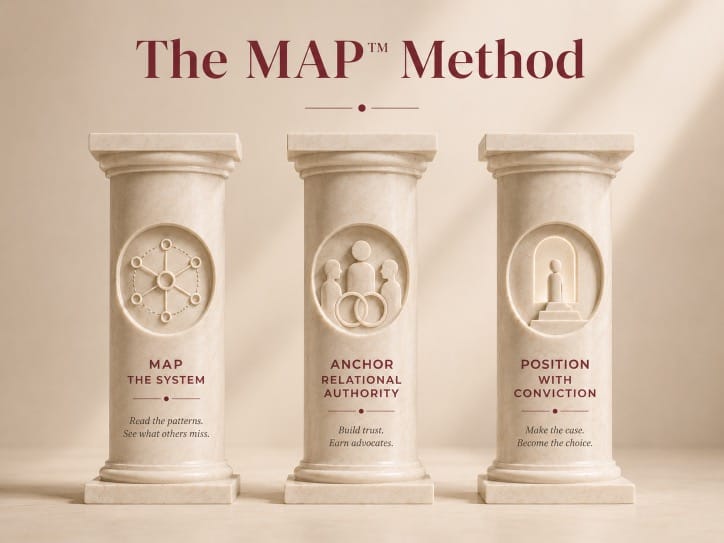
M — Map the System
Every organisation has two structures.
The formal one: org charts, reporting lines, official decision-making processes.
The real one: who actually shapes decisions before the meeting happens, whose support is needed before anything moves, where your work is visible and where it is not.
Most professionals operate entirely within the formal structure. They prepare well. They deliver strong results. They cannot understand why the outcome does not reflect the quality of their contribution.
The M pillar develops the ability to read both structures accurately. Where real influence sits. How decisions form. Where you currently sit in that picture — and where you need to be.
Systemic thinking applied to your actual career. Not abstract. Diagnostic.
A — Anchor Relational Authority
A title gives you a position on an org chart.
Relational authority is what gives you reach beyond it.
The professionals who get heard in complex organisations are not always the most senior ones. They are the ones other people trust. Trust built through consistent, honest, genuinely useful interactions over time. It does not appear on demand. It either exists or it does not.
The A pillar develops that trust deliberately. With the right people. Through the right interactions. At the right frequency.
This is distinct from networking. It is the targeted development of the relationships that determine your access to decisions, information, and opportunity inside your organisation.
P — Position with Conviction
Influence requires a position. A real one that you can hold.
Many experienced professionals have learned to qualify their views carefully, read the room before speaking, and adjust based on who is present. Often for sensible reasons. Over time, that habit creates a specific problem: nobody knows what you actually stand for.
The P pillar develops three capacities in sequence.
Clarity: knowing what you think and being able to state it plainly.
Courage: saying it in rooms where it is uncomfortable to say.
Confidence: the grounded version — not performance, but the internal security that comes from trusting your own judgment.
Culture shapes how you deliver all three. In some organisations directness is respected. In others, building coalition before going public is essential.
The MAP™ Method accounts for this. Position with Conviction does not mean one style. It means knowing where you stand clearly enough to adapt how you show up to the context in front of you.
Why the three pillars work together
Each pillar addresses a different layer of the same problem.
Map the System gives you accurate information about your environment. Without it, you are navigating blind.
Anchor Relational Authority gives you access to the people who matter. Without it, even a strong position does not land.
Position with Conviction gives you presence. Without it, the information and the access produce nothing.
Each one reinforces the others. Working on one in isolation produces limited results. Working on all three is what shifts how you are read by the organisation around you.
See the MAP™ Method in practice
I teach all three pillars in my recorded masterclass Power and Influence at Work.
In that session I walk through each one with real workplace examples, including how organisational culture changes the way you apply the framework, and the patterns that keep strong performers from advancing despite consistent results.
If you want to work through it in your own context, the 1:1 coaching programme is where that happens.